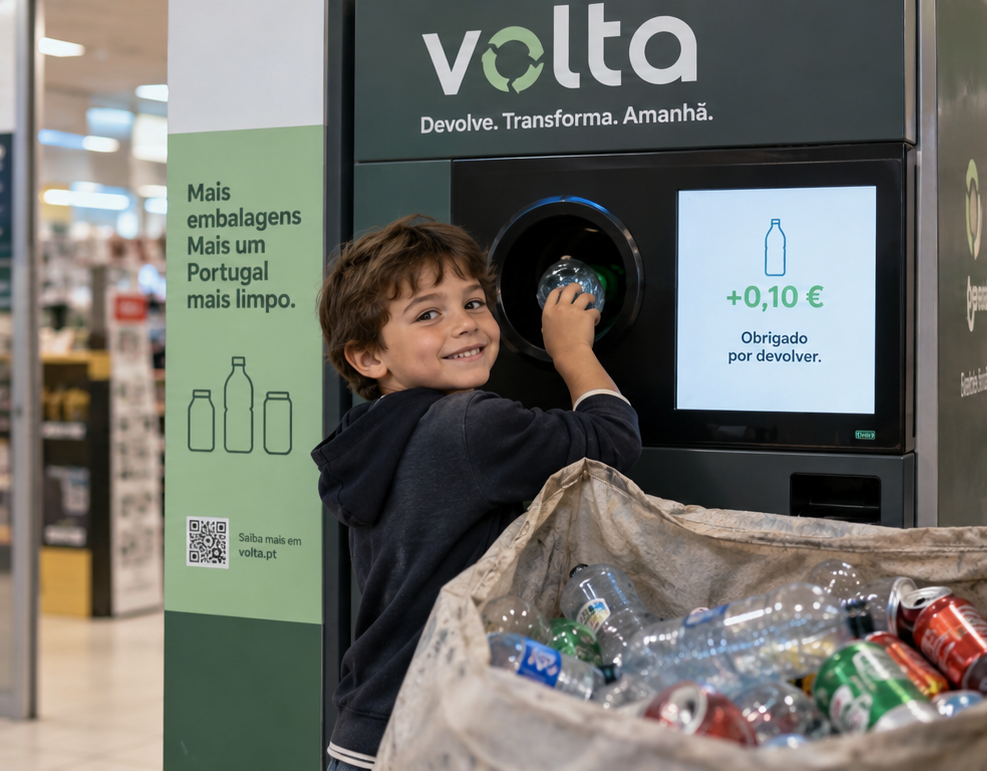
Portugal counts its bottles, but not the people returning them
Volta is beating its collection target. That target was revised down three weeks after the scheme started, and consumer behaviour wasn't the reason.
Five months after Volta started, 304 million bottles and cans have come back, and the return rate for single-use plastic bottles stands at 44%, past the 40% target set for the end of 2026. That target used to be 70%.
It was revised down three weeks after the launch, in a document signed by the environment agency APA and the economy directorate DGAE. The reason wasn't consumer behaviour: the rules for working out what producers pay into the scheme had been handed in at the end of January and still weren't approved. The national association of municipalities wanted a fuller explanation.
A petition with more than 46,000 signatures now sits with parliament's environment committee, asking for the scheme to be suspended and for SDR Portugal, the private association that runs it, to face an independent audit. Its main financial claim is that SDR expects only 40% of containers back, so 60% of the deposits stay with the operator. But that 40% is a first-year figure, not a forecast. The licence requires 80% by 2027 and 90% by 2029.
The worry behind the claim is real enough, because deposits nobody comes back for do stay inside the system. SDR says that money goes into running it, and that unclaimed vouchers stay on the books for three years and can only be spent once the collection targets are met. Nobody explained that in public, which is how 46,000 people signed a text that gets the arithmetic wrong.
Then there are the people. The Behavioral Insights Unit at Católica-Lisbon found that 82.8% of those it surveyed describe their knowledge of the scheme as good, yet 35.5% have never used it and 36.4% use it often or always. Those two ends are almost the same size, and that can still sit alongside a return rate of 44%, because the two count different things. A return rate counts containers, a survey counts people.
The 10 cents also doesn't have to go back to the person who paid it at the till. It travels with the bottle, to whoever picks it up.
In Faro, eight-year-old Mateus Salvador has spent about a year collecting bottles and cans to pay for a 3D printer. He needs roughly 7,000 of them, worth some €700, and he is past halfway, with relatives, friends, strangers and a local shop now saving their empties for him.
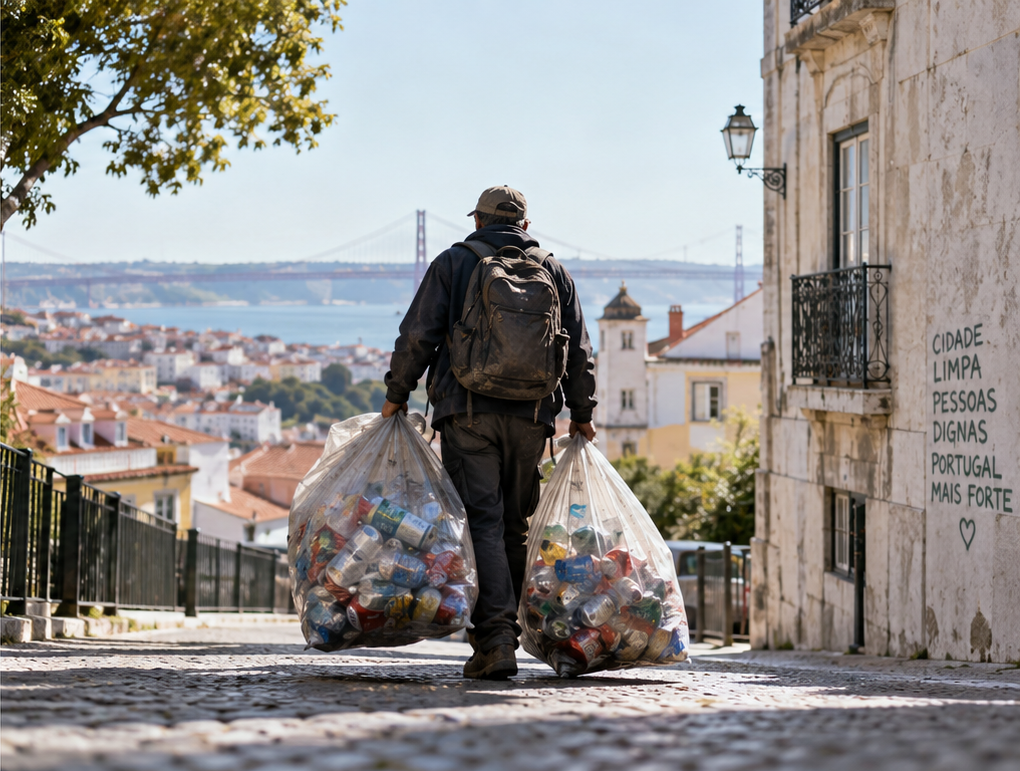
In Lisbon and Porto, the homelessness charity CASA describes people for whom collecting has become the day's work. Its director-general has seen someone make €40 in a day, which is 400 containers, and describes clients who turned down jobs and two who relapsed, once collecting paid better than a back-to-work scheme worth €537 a month. He wants the scheme redesigned, not scrapped.
Environment minister Maria da Graça Carvalho won't end it. Poverty and homelessness came before Volta, she says, and her ministry is looking at a fix used elsewhere in Europe that keeps deposit containers separate from the rest of the rubbish. She's right about the cause, but Volta still put a cash value on something that used to be worthless, and nobody planned for what that would do on a Lisbon street.
Ending the scheme isn't really a possibility anyway. EU Regulation 2025/40 tells Portugal to collect 90% of single-use plastic bottles and metal cans separately by January 2029, in principle through a deposit system, and only countries already at 80% can ask to be let off. Portugal is at 44%.
That leaves the figure nobody has published, because a total of 304 million returns can describe two very different countries. In one, most households bring a bag back every few weeks. In the other, a small group walks the streets for hours while everyone else pays the deposit and leaves it behind. The total looks the same either way, and SDR Portugal, which records every transaction, knows which one this is.
What Volta is, and what the 10 cents on your bottle pays for
Since 10 April 2026, single-use plastic bottles and metal cans under three litres carry a deposit of 10 cents in Portugal. You pay it at the till. You get it back when you return the empty container, intact, with the Volta symbol and a readable barcode.
Returns happen at more than 2,500 automated points, most of them inside supermarkets. There are also kiosks in 38 municipalities, aimed at bars, hotels and restaurants. The machine prints a voucher, which you redeem in store or move to a bank account through the Volta app. Containers without the symbol aren't accepted, and nor is anything the scheme doesn't cover, such as glass, cartons and bottles above three litres. Those all still belong in the yellow bin.
The scheme is run by SDR Portugal, a non-profit association set up by beverage producers and retailers, licensed and supervised by APA and the Directorate-General for Economic Activities. It cost about €150 million to build, and it's designed to handle roughly 2.1 billion containers a year. Deposits nobody reclaims stay inside the system, not paid out as profit.
Portugal was the 19th European country to introduce a scheme like this, and it did so under pressure. Collection through the yellow bins had stalled around 40%, and in July 2026 the European Commission opened infringement proceedings over Portugal's missed recycling targets. EU rules now require 90% separate collection of these containers by January 2029.