Ilhas de Biodiversidade


Ilhas de Biodiversidade plants dense native mini-forests with the Miyawaki method in industrial, educational and community settings across Portugal, pairing fast reforestation with scientific monitoring and community involvement.
Ilhas de Biodiversidade (*Islands of Biodiversity*) plants dense mini-forests of native species in very different urban settings: shipyards, schools, service stations, corporate campuses and senior care homes. Vítor Gordo founded the project in 2022.
It uses the Miyawaki method, developed by the Japanese botanist Akira Miyawaki, which copies the structure of a primary forest. The soil is analysed and then prepared intensively. Native species are chosen to fill several vegetation layers and planted densely, at 3 to 7 plants per square metre. Compared with conventional reforestation, a forest planted this way grows up to 10 times faster and hosts up to 30 times more biodiversity.
The first island went in at the Lisnave shipyard in Lisbon in November 2022. There are now nine planted islands, covering 450 m² with over 1,350 trees and shrubs, and a tenth is being prepared at Escola Bela Vista in Setúbal. The sites include schools (Noesis/ESCS, ISEL, Escola Sebastião da Gama and Escola Secundária Amora), a senior residence (Residência Egas Moniz), a service station on the A5 motorway, and corporate partners such as Capgemini.
The work combines documentary photography, scientific monitoring and community involvement. Ecowitt sensors in several of the islands track soil moisture, temperature and rainfall continuously and in real time, and the data is shared openly for educational use. At partner schools, students do the measuring, the weeding and the data analysis themselves. Species observations are logged on the iNaturalist app and feed a growing biodiversity atlas.
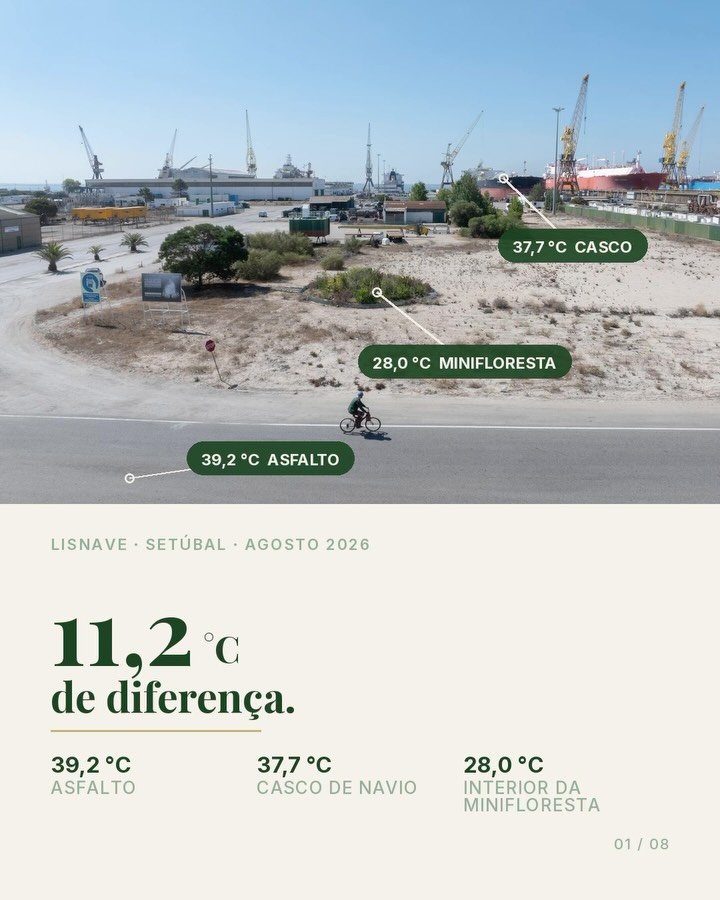
Temperature differences of more than 20 °C have been measured between the forest floor and the asphalt next to it, which shows the islands working as climate infrastructure rather than as decorative greenery. The project is part of Portugal's national mini-forest network.
Our Goal
Ilhas de Biodiversidade plants dense native mini-forests with the Miyawaki method in unlikely urban locations, such as shipyards, schools, service stations and senior residences. These become fast-growing, self-sustaining ecosystems that cool their surroundings and restore biodiversity.
Our Wishes
The project is looking for new partners (companies, schools and institutions) willing to host a new biodiversity island and to support the monitoring and community planting events.